
10 Ways to Differentiate to Meet Student Needs
Updated for 2026-27
MathFactLab offers several ways you can differentiate to better meet student needs:
- Adjusting the Required Response Rate
- Changing the Passing Percentage for Level Lifter assessments
- Giving Level Lifter interviews
- Unlocking Level Lifters
- Advancing Students Manually
- Hiding Strategies/Activities
- Hiding Hints
- Text-to-Speech
- Student language selection
- Session Length
Adjusting the Required Response Rate
A student's Required Response Rate is the number of seconds they have to answer a problem for their response to be considered fluent. Response rates can be set anywhere from 2 to 120 seconds per problem and can be adjusted for individual students or groups of students.
Default Response Rates by Grade Level
Research generally recommends a response rate of 3 seconds as an indicator of math fact fluency. MathFactLab allows an additional second for students in fourth grade and above to account for typing time. Younger students receive more time to respond. MathFactLab automatically assigns a default response rate based on each student's grade level.
| Grade Level | Default Response Rate |
|---|---|
| Kindergarten | 7 seconds |
| Grades 1–2 | 6 seconds |
| Grade 3 | 5 seconds |
| Grade 4 and above | 4 seconds |
| No grade level assigned | 5 seconds |
Guidelines for Adjusting Response Rates - When deciding whether to change a student's Required Response Rate, consider the following:
- Allow for differences in processing speed. Students vary considerably in how quickly they process information and respond. We anticipate that approximately 20% of students will benefit from a more generous response rate than the default. Adjust response rates as needed to provide an appropriate balance between challenge and success, helping students remain engaged and make meaningful progress.
- Remember that mathematical ability and response speed are not the same. Some students with strong mathematical understanding may still need additional time to respond. A slower response does not necessarily indicate difficulty with the underlying math concepts.
- Avoid allowing more time than necessary for addition and subtraction. One goal of MathFactLab is to help students move beyond counting strategies, such as counting on or using their fingers, toward more efficient mental strategies. Response rates should provide enough time for students to succeed without unnecessarily encouraging continued reliance on counting.
- Consider a two-pass approach for multiplication and division. Some students benefit from working through the basic facts twice. During the first pass, assign a more generous response rate so students can develop confidence and accuracy. Once they have mastered the facts at that rate, have them work through the levels again using the default response rate for their grade. This approach allows students to build accuracy before focusing on speed.
- Consider a two-pass approach for multiplication and division. Some students benefit from working through the basic facts twice. During the first pass, assign a more generous response rate so students can develop confidence and accuracy. Once they have mastered the facts at that rate, have them work through the levels again using the default response rate for their grade. This approach allows students to build accuracy before focusing on speed.
The goal is to set a response rate that challenges students appropriately without creating unnecessary frustration. Teachers should monitor student progress and adjust response rates when needed to support both fluency development and continued success.
Click here to learn how to change student response rates.
Changing the Passing Percentage for Level Lifter Assessments
Teachers can adjust the passing requirements for Level Lifter assessments to provide an appropriate level of challenge while helping students remain motivated and make progress.
How Level Lifters Are Scored
A student's Level Lifter score is based on both the accuracy and fluency (speed) of their responses. Points are awarded as follows:
- Accurate and fluent responses: Full points
- Accurate but not fluent responses: Half points
- Inaccurate responses: No points
To pass a Level Lifter, students must earn a minimum percentage of the total possible points. This requirement is called the Passing Percentage.
Adjusting the Passing Percentage
The default Passing Percentage is 80%, but teachers can adjust it anywhere from 50% to 100% for individual students or groups of students.
Lowering the Passing Percentage may help students who are struggling to advance through the levels, while increasing it can provide an additional challenge for students who are ready for more demanding expectations.
The goal is to set a Passing Percentage that balances appropriate expectations with opportunities for students to experience success and continue making progress.
Click here to learn how to adjust the Passing Percentage for your students.
Level Lifter Interviews
Some students may have difficulty demonstrating their full understanding of math facts on standard Level Lifter assessments. For these students, MathFactLab offers Level Lifter Interviews as an alternative way to assess fluency and accuracy.
Level Lifter Interviews use the same questions as standard Level Lifters, but they are administered by the teacher using the teacher's device. Students respond orally rather than typing their answers, allowing them to demonstrate their math fact knowledge without the added demands of using a keyboard.
Teachers can administer a Level Lifter Interview at any time, even if the student has not yet unlocked the standard Level Lifter. However, we recommend that students complete the practice activities for their current level before taking an interview to ensure they are adequately prepared.
Click here to learn how to begin a Level Lifter Interview.
Unlocking Level Lifters
If you believe a student has had sufficient practice at their current level and is ready to take the Level Lifter, you can manually unlock the assessment without requiring the student to complete all the usual practice requirements.
Note: Manually unlocking a Level Lifter is a one-time action. After the student takes the assessment, the Level Lifter will be locked again. If the student does not pass, they will need to complete the usual practice requirements before they can retake it, unless the teacher manually unlocks it again.
Click here to learn how to unlock Level Lifters.
Advancing Students Manually
If you are confident that a student is ready to progress to the next level, or even skip a few levels, you can advance them manually.
Click here to learn how to change a student's level manually.
Hiding Strategies/Activities
MathFactLab allows teachers to hide specific strategies and activities for individual students, groups of students, or an entire class. This flexibility makes it possible to customize practice sessions to better meet students' needs
You may want to hide certain activities if:
- Students are unfamiliar with certain models or strategies and have not yet been introduced to them through classroom instruction.
- A student is struggling with a particular model or strategy and would benefit from focusing on more familiar approaches.
- You want to simplify students' practice sessions by reducing the number of activities available, allowing them to focus on a smaller selection.
Hiding activities can help make practice more manageable while allowing students to focus on strategies that best support their learning.
For the Addition and Subtraction Learning Mode:
The activities available by default depend on the student's grade level:
- Kindergarten and Grade 1: Only Ten Frames are enabled by default, providing younger students with a familiar, consistent model. Teachers can enable additional activities as students become comfortable with other models and strategies.
- Grade 2 and above: All activities are enabled by default. Teachers can hide up to six activities to better meet individual students' needs.
Note: Ten Frames are always enabled and cannot be hidden. Teachers may choose to hide any or all of the other addition and subtraction activities.
For the Multiplication and Division Learning Mode:
Teachers can choose to hide four specific activities:
- Number Lines
- Area Models
- Division with Dice
- Fingers Trick (for multiplication facts involving 9)
All other multiplication and division activities remain available.
Important: The option to hide or show activities is available only at the Basic Levels of both learning modes. These settings do not apply to Advanced or Challenge Levels.
Click here to learn how to hide strategies/activities.
Hiding Hints
Some students may become overly reliant on the Hint button rather than attempting to solve problems independently. To encourage greater independence, MathFactLab allows teachers to limit access to hints for individual students.
When this option is enabled:
- Hints remain available for the first five problems in each problem set, allowing students to become familiar with the model or strategy being practiced.
- The Hint button is hidden after the first five problems, encouraging students to apply the strategy independently.
- The Hint button is hidden after the first five problems, encouraging students to apply the strategy independently.
We recommend using this option only for students who have become overly dependent on hints, rather than for an entire class. Hints are an important learning support, particularly when students are becoming familiar with new models and strategies.
Text-to-Speech during Placement Test
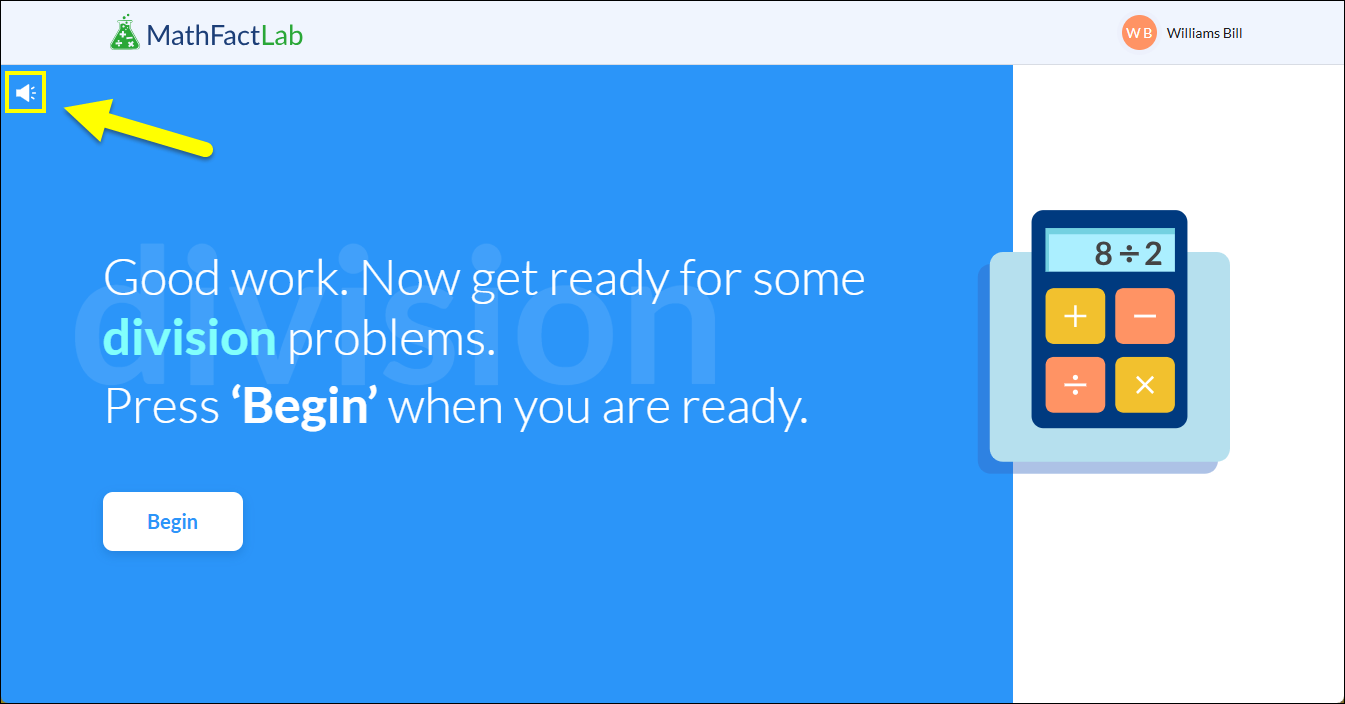
Students who have difficulty reading the instructions during the Placement Test can click the speaker icon in the upper-left corner of the screen to have the instructions read aloud.
Note: This audio assistance is available for the instructions only. It does not read the math problems aloud.
Student Language Selection
MathFactLab is available in English, Spanish, and French. Teachers can select the language that best meets each student's needs.
Language settings can be changed for individual students or multiple students at once, making it easy to accommodate different language preferences within a class.
Important: If students are already using MathFactLab when their language setting is changed, they must log out and log back in for the new language setting to take effect.
Click here to learn how to adjust language settings.
Adjusting Session Length
Students are automatically logged out of MathFactLab at the end of each practice session. Teachers and administrators can adjust session lengths to accommodate different schedules and instructional needs. For example, you may want students to have longer sessions on some days and shorter sessions on others. The default session length is 12.5 minutes.
Session lengths can be set from 5 to 20 minutes and adjusted for individual students or multiple students at once.
For additional guidance, see:
- Recommended Student Usage per Week – Recommendations for how frequently and how long students should practice.
- How to Change Student Session Lengths – Step-by-step instructions for adjusting session lengths for individual students or groups.
@zoho